Author name: DylanFong

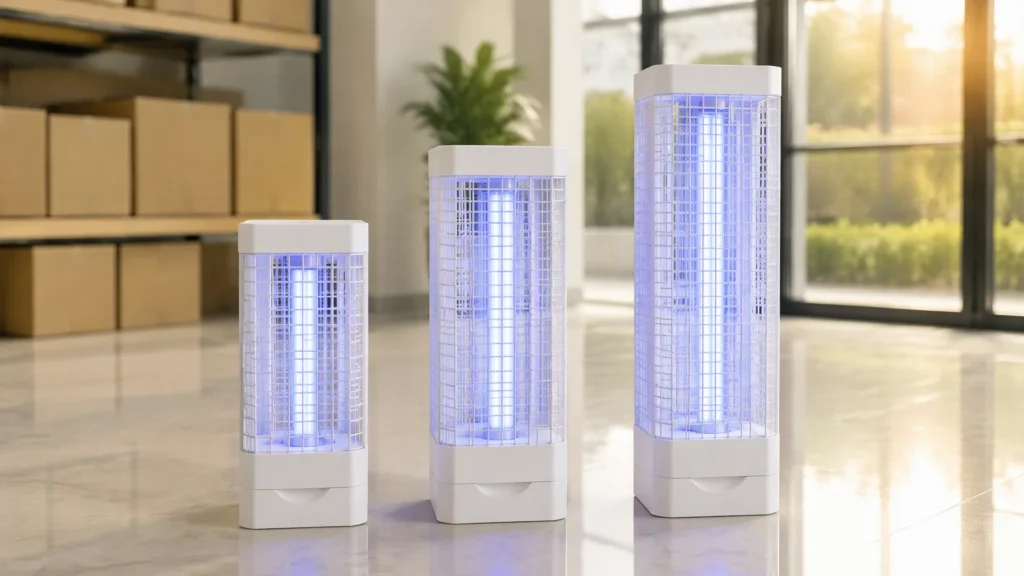
Three white vertical 3D upright electric mosquito killers from the same family at three different heights, the 10W, 15W and 20W models, standing in a row and switched on in a bright distributor showroom, each showing its protective mesh, a glowing 365nm UV-A tube inside the chamber and a collection tray at the base. Every model in the range carries the same 1800V electric grid; the specification that changes along the row is tube power, chamber length and stated coverage. Clean white product housings, no logo, no brand name, no model number, no certification marking and no text on the unit bodies, bases, meshes or trays, with plain unbranded cartons on blurred shelving behind.
News

What Does 1800V Mean in an Electric Mosquito Killer?

1800V is the potential difference the step-up stage maintains across the killing grid while nothing is touching it: a rating of the kill stage, not a performance score. This B2B guide covers what the figure measures and what it cannot tell you, why the grid cannot run at 220V, why 1800V is identical across the 10W, 15W and 20W models, how supplier wordings change its meaning, what has to be true for it to matter, how to verify it before ordering, and what the Gulf environment does to a high-voltage grid.

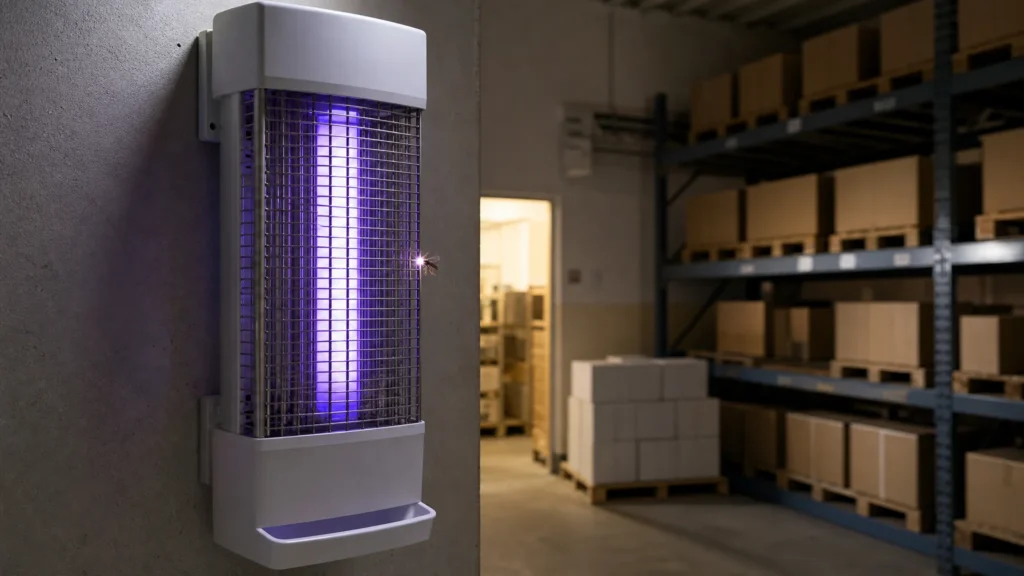
White vertical 3D upright electric mosquito killer wall-mounted and operating in a Middle East supermarket back-of-house stockroom at night, its outer protective mesh revealing a glowing 365nm UV-A tube and the inner high-voltage electrode grid, with a single small moth in contact with the mesh showing a pinpoint spark at the moment of electrical contact. Steel shelving holds plain blank export cartons and a pallet of plain white product cartons stands near the wall, with warm light spilling through an open doorway. Clean white product housing, no logo, no brand name, no model number, no certification marking, no text on the unit body, base, mesh or grid, and no printing or writing on the cartons.
News

How Does a High-Voltage Electric Mosquito Killer Work?

A high voltage electric mosquito killer kills by electrocution: a step-up circuit raises the 220V / 50Hz mains supply to 1800V at an electrode grid behind a protective mesh, and when an insect attracted by the 365nm UV-A tube makes contact, its own body bridges the circuit and a brief current-limited pulse passes through it. This B2B guide covers the six-stage energy chain, why current limiting and enclosure make the device safe in occupied rooms, the eight specification items to confirm in writing, and what high-voltage killing does not do.

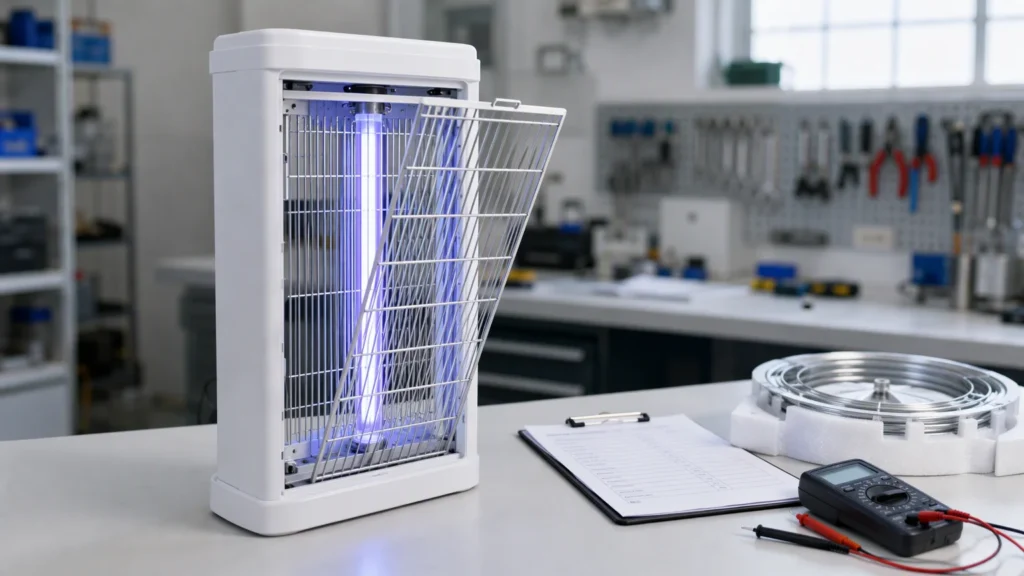
White vertical 3D upright electric mosquito killer standing on an engineering inspection bench with its front protective mesh panel lifted and swung open, revealing the interior kill stage: a glowing 365nm UV-A tube running vertically in the centre, surrounded by a fine parallel-wire high-voltage electrode grid of polished metal wires on an inner aluminium frame. On the bench beside the unit are a printed engineering inspection checklist on a clipboard, a digital multimeter with red and black test leads, and a coiled replacement wire-grid spool resting in a white foam cradle. The background is an out-of-focus modern factory QC laboratory with a tool pegboard and soft daylight from a high window. Clean white plastic housing, no logo, no brand name, no model number, no text, no certification marking on the unit body, base, mesh or grid.
News

What Is the Role of the Electric Grid in a Bug Zapper?

The electric grid in a bug zapper is the kill stage: an enclosed 1800V electrode inside the protective mesh that completes the circuit when an insect attracted by the 365nm UV-A tube makes contact, and drops the result into the collection tray. This B2B guide covers what the grid does, how to judge one for indoor commercial use, why grid performance does not scale with tube wattage, the failure modes that stop units killing, and the eight procurement items to confirm in writing.

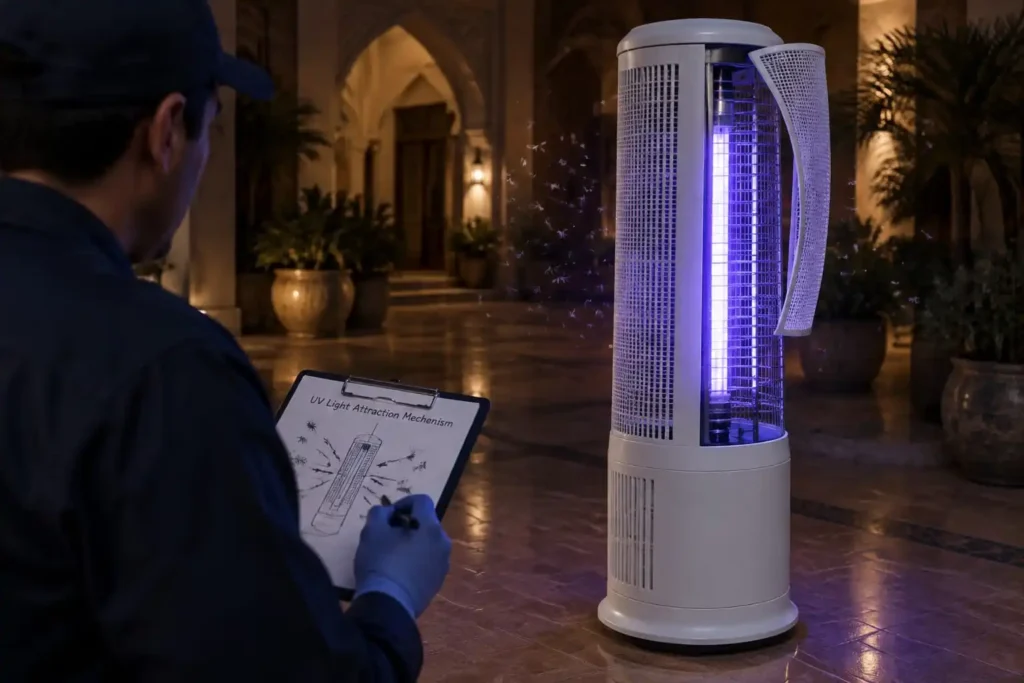
White vertical 3D upright electric mosquito killer with glowing 365nm UV-A tube in a darkened hotel back-of-house indoor courtyard at night, showing a soft swarm of small flying insects (mosquitoes, gnats, moths) visibly attracted and circling in the faint UV-A glow around the protective outer mesh. A pest control professional in navy uniform and disposable gloves is observing from a 3-meter distance with a clipboard titled 'UV Light Attraction Mechanism' and a pen, sketching a behavioural diagram showing insects flying inward toward the tube. The unit's protective outer mesh is partially lifted, revealing the glowing tube and 1800V grid inside. Background features faint illuminated Middle Eastern style archways, ceramic tile flooring, and a few potted plants in soft focus. Clean white product housing, no logo, no brand name, no text, no certification marking on the unit body, base or grid.
News

How Does UV Light Attract Flying Insects?

UV light attracts flying insects through positive phototaxis – a hard-wired evolutionary response in which the compound eye, tuned to the 345-370nm UV-A band, detects the artificial 365nm source and the insect flies toward it. This B2B guide explains the phototaxis mechanism, the compound-eye biology, the light-funnel sequence inside the unit, the species that respond, five practical variables that change attraction strength, and the eight procurement items for verifying attraction performance in writing.

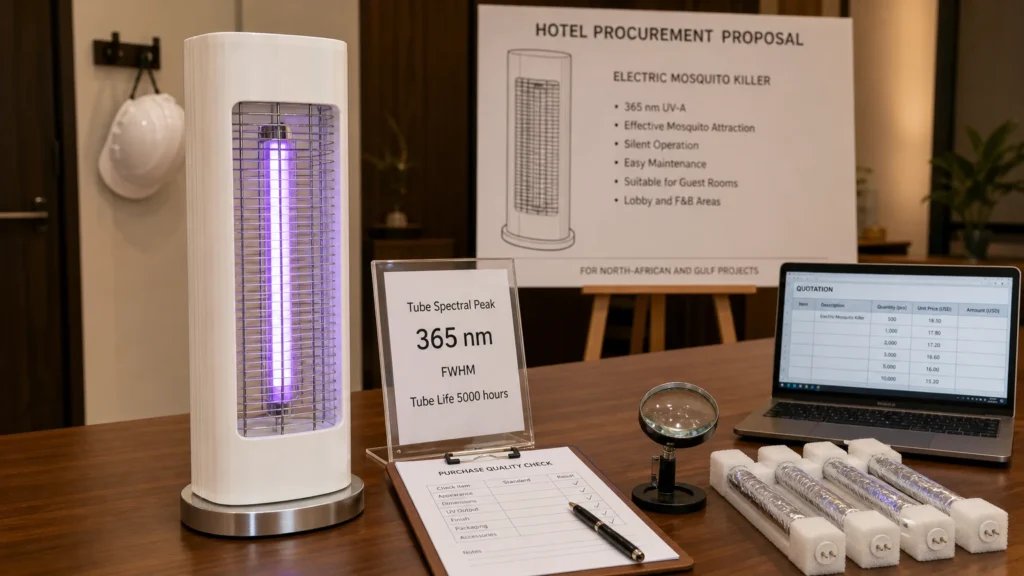
White vertical 3D upright electric mosquito killer with glowing 365nm UV-A tube clearly visible inside the open protective outer mesh, presented on a polished walnut inspection table in a B2B procurement office. To the right of the unit: a printed datasheet in a clear acrylic stand showing Tube Spectral Peak 365 nm, FWHM and Tube Life 5000 hours. Beside the datasheet: a purchase quality check clipboard with ticked criterion boxes (Appearance, Dimensions, UV Output, Finish, Packaging, Accessories), a desktop magnifier, three spare UV tubes wrapped in foam cradles and a slim laptop showing a quotation spreadsheet with quantity and unit price columns. Background: a hotel procurement proposal easel showing the electric mosquito killer line drawing with 365 nm UV-A, Effective Mosquito Attraction, Silent Operation, Easy Maintenance, Suitable for Guest Rooms, Lobby and F&B Areas, and a soft-focus inspector safety helmet on a wall hook. Clean white product housing, no logo, no brand name, no model number, no certification marking, no text anywhere on the unit body, base or grid. Warm professional B2B procurement office lighting.
News

What Is the Best UV Wavelength for an Electric Insect Killer?

The best UV wavelength for a commercial electric insect killer is 365nm UV-A. It sits in the phototactic peak band for mosquitoes, gnats, moths and houseflies, is safe for short indoor human exposure, and pairs with an 1800V enclosed grid. This B2B guide walks through six practical variables, eight procurement items for confirming the wavelength, FWHM and replacement supply line in writing, and the application context for every buyer channel.

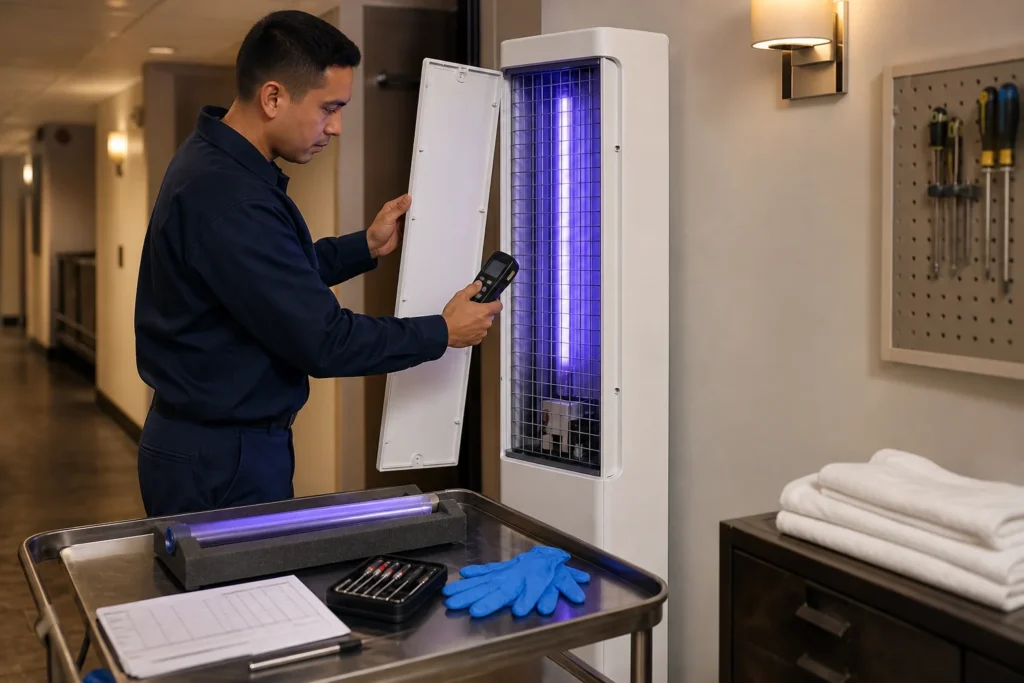
White vertical 3D upright electric mosquito killer with glowing 365nm UV-A tube clearly visible through the protective outer mesh, accessed in a darkened hotel back-of-house service corridor by a maintenance technician in navy workwear holding a handheld UV wavelength meter pointed at the tube, with a slim metal service cart in the foreground carrying a foam-cradled replacement UV tube, nitrile gloves, a precision screwdriver set and a paper checklist clipboard - clean white product housing, no logo, no brand name, no text, no certification marking, no model number on the unit body, soft violet UV-A glow against warm cream corridor walls
News

Why Is 365nm UV Light Used in Electric Mosquito Killers?

365nm UV-A is used in electric mosquito killers because it sits at the phototactic peak for flying insects – the compound-eye band their visual system evolved to navigate by. This B2B guide walks through the phototaxis science, the 365nm versus 395nm versus 254nm comparison, the 1800V enclosed grid kill mechanism, and the procurement items for confirming tube wavelength, tube life and replacement-tube supply line in writing.

White vertical 3D upright electric mosquito killer wall-mounted in an upscale hotel restaurant dining room with glowing 365nm UV-A tube inside the protective mesh, set against warm beige interior with arabesque wall panel and brass sconce, dining tables visible in soft-focus background
News

How Effective Are Electric Mosquito Killers for Hotels and Restaurants?

Vertical 3D upright electric mosquito killers are highly effective for hotels and restaurants when the configuration is matched to the room size, placed away from direct guest sightlines, and run continuously. Learn the seven effectiveness factors that matter most for hospitality, the room-by-room configuration recommendations, the comparison with chemical spraying and traps, and the B2B procurement items to confirm in writing for hotel and restaurant chains.

Scroll to Top